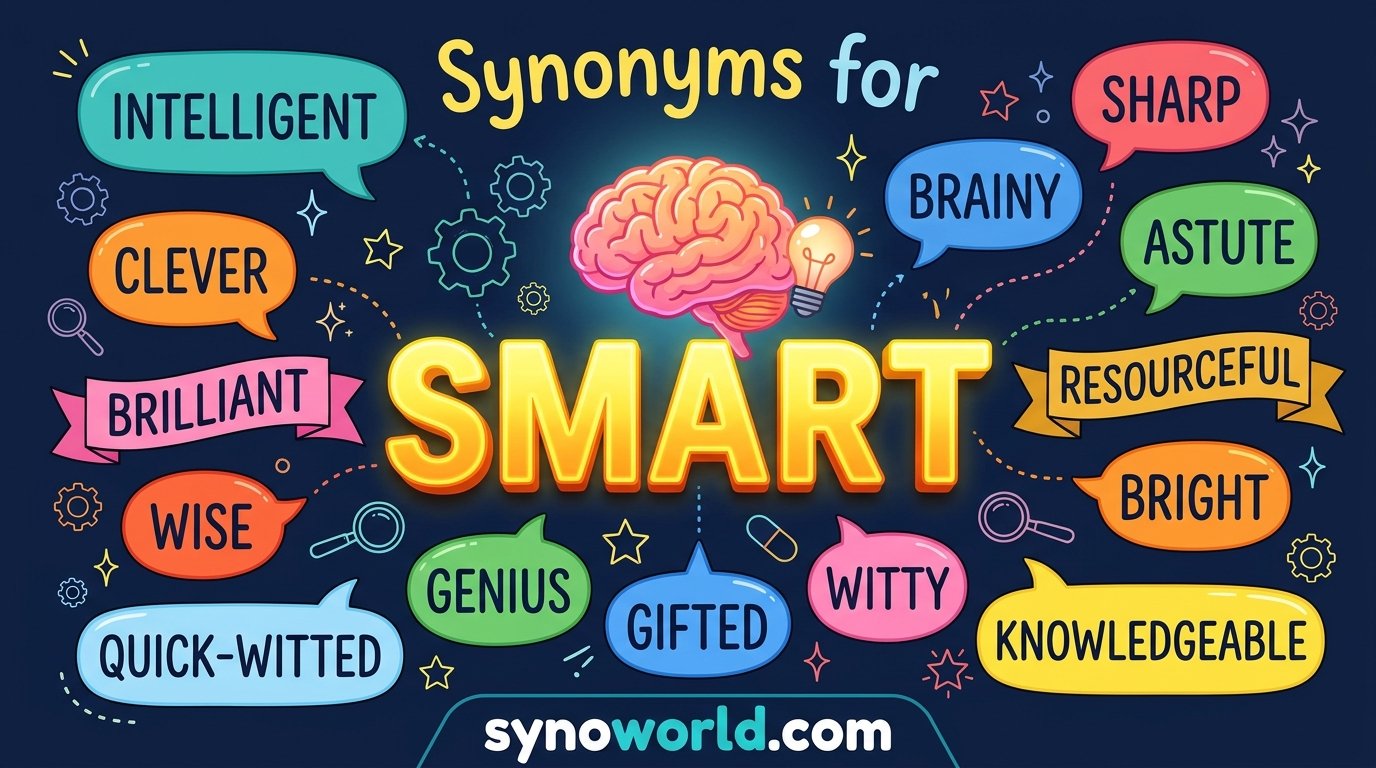
Finding the right synonym for smart can make your English clearer, more natural, and more expressive. Common synonyms include intelligent, clever, bright, brilliant, wise, sharp, perceptive, and knowledgeable.
Although these words share a similar meaning, each describes a slightly different quality, such as quick thinking, deep understanding, practical judgment, or academic ability. This guide explains 30 synonyms for smart with simple definitions, example sentences, and advice on when to use each word.
Quick Answer: What Are the Best Synonyms for Smart?
The best synonyms for smart depend on the situation:
- Intelligent: Having a strong ability to learn, understand, and reason.
- Clever: Finding quick or creative ways to solve problems.
- Bright: Learning and understanding things quickly.
- Brilliant: Exceptionally intelligent or impressive.
- Wise: Showing good judgment based on knowledge and experience.
- Sharp: Thinking quickly and noticing details.
- Knowledgeable: Having a lot of information about a subject.
- Perceptive: Understanding things that others may overlook.
- Astute: Making accurate judgments in complicated situations.
- Resourceful: Finding practical solutions when difficulties arise.
For everyday English, smart, intelligent, clever, and bright are excellent general choices. For formal writing, intellectual, astute, and analytical may be more suitable. When describing someone with good judgment, wise is often the better word.
What Does Smart Mean?
The word smart has several meanings. Most commonly, it describes someone who can learn, understand, reason, or solve problems effectively.
However, smart can also describe practical decisions, stylish clothing, or something that shows good design.
Consider these examples:
- Intelligence: She is a smart student who understands difficult concepts quickly.
- Practical judgment: That was a smart decision.
- Problem-solving: He found a smart way to fix the issue.
- Appearance: He wore a smart suit to the interview.
When searching for synonyms, it is important to understand which meaning of smart you want to express. A word such as brilliant may describe exceptional intelligence, while stylish is more appropriate when smart refers to appearance.
30 Synonyms for Smart With Meanings and Examples
The following words are useful for students, English learners, writers, teachers, and anyone who wants to improve their vocabulary.
1. Intelligent
Simple meaning: Able to learn, understand, and think logically.
Example: Maria is an intelligent student who enjoys solving difficult problems.
Best usage: Use intelligent when describing someone’s general mental ability. It works well in academic, professional, and everyday situations.
2. Clever
Simple meaning: Good at thinking quickly and finding effective or creative solutions.
Example: He came up with a clever way to save time during the project.
Best usage: Use clever when someone solves a problem through quick thinking, ingenuity, or an unusual idea. Depending on context, it can occasionally suggest trickiness.
3. Bright
Simple meaning: Quick to learn and understand new information.
Example: The teacher believes that every bright student deserves opportunities to learn.
Best usage: Use bright in friendly, informal, and educational contexts. It is particularly common when describing children, students, and promising learners.
4. Brilliant
Simple meaning: Exceptionally intelligent, talented, or impressive.
Example: She developed a brilliant solution to a complicated mathematical problem.
Best usage: Use brilliant to express strong admiration for someone’s intelligence, ideas, or achievements. It is more emphatic than smart.
5. Wise
Simple meaning: Able to make good decisions using knowledge, experience, and sound judgment.
Example: My grandfather gave me wise advice about managing money.
Best usage: Use wise when judgment and experience matter more than quick thinking or academic ability.
6. Sharp
Simple meaning: Quick to understand, think, and notice things.
Example: Even after a long meeting, she remained sharp and attentive.
Best usage: Use sharp in everyday conversations and professional settings to describe quick thinking, mental alertness, or keen observation.
7. Quick-witted
Simple meaning: Able to think and respond quickly, especially in conversation.
Example: The quick-witted speaker answered every unexpected question confidently.
Best usage: Use quick-witted when someone responds cleverly under pressure or produces amusing and intelligent replies.
8. Astute
Simple meaning: Good at understanding situations and making accurate judgments.
Example: The astute manager noticed a problem before it affected the team.
Best usage: Use astute in business, leadership, politics, and formal writing when someone demonstrates practical insight.
9. Perceptive
Simple meaning: Good at noticing and understanding details, feelings, or hidden meanings.
Example: Her perceptive comments helped us understand why the customer was upset.
Best usage: Use perceptive when someone recognizes things that others might miss, particularly in social situations or detailed analysis.
10. Knowledgeable
Simple meaning: Having a great deal of information or understanding about a subject.
Example: Our knowledgeable guide explained the history of the ancient city.
Best usage: Use knowledgeable when describing someone’s expertise or familiarity with a topic. It emphasizes what a person knows rather than how quickly they think.
11. Intellectual
Simple meaning: Related to careful thinking, reasoning, and the understanding of ideas.
Example: The book offers an intellectual discussion of freedom and responsibility.
Best usage: Use intellectual in academic, philosophical, and formal contexts. When describing a person, it often suggests an interest in ideas and serious thinking.
12. Gifted
Simple meaning: Naturally talented or unusually capable in a particular area.
Example: The gifted musician learned to play several instruments at a young age.
Best usage: Use gifted when someone shows exceptional ability in a field such as mathematics, music, writing, or science.
13. Talented
Simple meaning: Having a natural ability or developed skill.
Example: She is a talented designer who creates practical and attractive products.
Best usage: Use talented to emphasize ability in a particular activity. It is not an exact substitute for intelligent because talent may involve artistic, physical, or technical skills.
14. Ingenious
Simple meaning: Very clever and original, especially when creating solutions.
Example: The engineer invented an ingenious device that uses less energy.
Best usage: Use ingenious for inventive ideas, clever designs, and creative problem-solving. It is especially useful in technical and descriptive writing.
15. Resourceful
Simple meaning: Good at finding ways to solve problems with the resources available.
Example: The resourceful traveler found a safe route when the main road was closed.
Best usage: Use resourceful when someone handles difficult situations independently and practically.
16. Analytical
Simple meaning: Able to examine information carefully and understand how its parts relate.
Example: His analytical approach helped the team identify the cause of the error.
Best usage: Use analytical in research, science, education, business, and problem-solving contexts.
17. Logical
Simple meaning: Able to think in a clear, reasonable, and organized way.
Example: She presented a logical argument supported by clear evidence.
Best usage: Use logical when a person’s reasoning follows sensible steps. It can describe an argument or decision rather than a person’s overall intelligence.
18. Rational
Simple meaning: Based on reason and evidence rather than uncontrolled emotion.
Example: They made a rational decision after reviewing the available information.
Best usage: Use rational in discussions about decisions, arguments, and judgment. It emphasizes reasonableness rather than intelligence alone.
19. Insightful
Simple meaning: Showing a deep understanding of a subject or situation.
Example: The student wrote an insightful essay about human behavior.
Best usage: Use insightful for observations, comments, essays, and analyses that reveal something meaningful.
20. Savvy
Simple meaning: Practical knowledge and good judgment in a particular area.
Example: She is a savvy shopper who compares prices before buying anything.
Best usage: Use savvy in informal or professional contexts involving business, technology, money, marketing, or everyday decisions.
21. Shrewd
Simple meaning: Clever at judging situations, especially when making practical or strategic decisions.
Example: The shrewd negotiator secured a better agreement for the company.
Best usage: Use shrewd for strategic thinking in business, negotiations, and competition. Depending on context, it may imply self-interest or a calculating attitude.
22. Brainy
Simple meaning: Very intelligent, especially in academic or intellectual matters.
Example: His brainy sister enjoys solving advanced mathematics problems.
Best usage: Use brainy in casual conversation and friendly descriptions. It is informal and may sound playful.
23. Brilliant-minded
Simple meaning: Having an exceptionally intelligent or creative mind.
Example: The brilliant-minded researcher proposed a new explanation for the findings.
Best usage: Use this expression when you want an emphatic description of someone’s intellectual ability. In most ordinary writing, brilliant or highly intelligent sounds more natural and concise.
24. Educated
Simple meaning: Having received education or gained knowledge through learning.
Example: An educated reader can evaluate different viewpoints and examine supporting evidence.
Best usage: Use educated when emphasizing someone’s education or learning background. Remember that formal education and intelligence are not the same thing.
25. Erudite
Simple meaning: Having extensive knowledge, especially from reading and studying.
Example: The erudite professor discussed the origins of the ancient text.
Best usage: Use erudite in formal, literary, and academic writing. It is less common in everyday conversation.
26. Judicious
Simple meaning: Showing careful and sensible judgment.
Example: The director made a judicious choice about how to distribute the budget.
Best usage: Use judicious when describing thoughtful decisions that consider risks, benefits, and circumstances.
27. Discerning
Simple meaning: Able to recognize differences in quality, value, or importance.
Example: A discerning reader can distinguish strong evidence from unsupported opinions.
Best usage: Use discerning for people who make careful distinctions or recognize quality in art, writing, products, and ideas.
28. Competent
Simple meaning: Having the necessary ability and skills to perform a task successfully.
Example: She is a competent researcher who completes her work carefully.
Best usage: Use competent in workplaces, education, and practical situations. It emphasizes reliable ability rather than exceptional intelligence.
29. Brainy
Simple meaning: Showing strong intellectual ability or an interest in difficult ideas.
Example: The brainy teenager enjoys reading books about astronomy.
Best usage: Use brainy in informal descriptions, particularly when talking about academic interests. Because it already appears in this list, consider intellectually gifted as a more formal alternative when you need a different expression.
30. Level-headed
Simple meaning: Calm and sensible when dealing with difficult situations.
Example: The level-headed team leader stayed calm during the emergency.
Best usage: Use level-headed when someone makes sensible decisions without panicking. It describes emotional control and practical judgment more than raw intelligence.
Comparison Table: Which Synonym for Smart Should You Use?
The table below highlights the main differences between commonly used synonyms.
| Synonym | Main quality | Tone | Best context |
| Intelligent | General mental ability | Neutral | General descriptions |
| Clever | Quick, creative thinking | Neutral | Solutions and ideas |
| Bright | Fast learning | Friendly | Students and learners |
| Brilliant | Exceptional ability | Strong praise | Achievements and ideas |
| Wise | Good judgment | Respectful | Advice and life decisions |
| Sharp | Mental alertness | Informal to neutral | Quick thinking |
| Astute | Practical insight | Formal | Business and leadership |
| Perceptive | Awareness and insight | Neutral | People and behavior |
| Knowledgeable | Subject expertise | Neutral | Specialists and experts |
| Ingenious | Original invention | Positive | Designs and solutions |
| Analytical | Careful examination | Professional | Research and problem-solving |
| Savvy | Practical know-how | Informal | Business and everyday skills |
| Erudite | Extensive learning | Formal | Academic writing |
| Judicious | Careful judgment | Formal | Decisions and policies |
| Level-headed | Calm reasoning | Neutral | Stressful situations |
How to Choose the Right Synonym for Smart
Choosing the right word depends on what you want to communicate. The following guide organizes synonyms by tone, meaning, and intention.
1. For Everyday Conversations
Choose simple, familiar words that sound natural.
- Smart: He is a smart kid.
- Clever: That was a clever idea.
- Bright: She is a bright student.
- Sharp: You are sharp today.
- Brainy: My brother is really brainy.
These expressions work well in casual conversations, school discussions, and informal writing.
2. For Academic and Professional Writing
Choose words that describe a specific ability or intellectual quality.
- Intelligent: The study examines how intelligent learners approach unfamiliar problems.
- Analytical: An analytical approach helps identify patterns in the data.
- Intellectual: The course encourages intellectual curiosity.
- Knowledgeable: The knowledgeable instructor explained the subject clearly.
- Erudite: The erudite author draws on a wide range of historical sources.
These words are useful for essays, reports, professional biographies, and academic descriptions.
3. For Creativity and Innovation
Choose words that emphasize original thinking and inventive solutions.
- Clever: She found a clever way to organize the files.
- Ingenious: The team designed an ingenious water-saving system.
- Brilliant: His brilliant idea transformed the project.
- Resourceful: The resourceful student completed the experiment with limited equipment.
Use these words when the person’s creativity or ability to solve problems is more important than general intelligence.
4. For Good Judgment and Decision-Making
Choose words that highlight sound reasoning and practical understanding.
- Wise: It was wise to ask for advice.
- Astute: The astute investor noticed a change in the market.
- Shrewd: The shrewd buyer negotiated a lower price.
- Judicious: The committee made a judicious choice.
- Level-headed: She remained level-headed during the disagreement.
These synonyms are especially useful when discussing leadership, relationships, money, and difficult choices.
5. For Social Awareness and Understanding
Choose words that describe someone’s ability to understand people and situations.
- Perceptive: He made a perceptive observation about the conversation.
- Insightful: Her insightful comments helped resolve the misunderstanding.
- Discerning: The discerning editor noticed subtle differences in meaning.
- Sharp: She has a sharp eye for detail.
These expressions work well when describing emotional awareness, careful observation, or an understanding of complex situations.
Common Mistakes When Using Synonyms for Smart
Although many words are similar to smart, they are not interchangeable in every sentence.
Mistake 1: Treating Wise and Intelligent as Identical
Intelligence involves learning, understanding, and reasoning. Wisdom involves using knowledge and experience to make good decisions.
Less precise: He is wise at solving complex equations.
More natural: He is intelligent enough to solve complex equations.
However, wise is appropriate when discussing important life decisions or thoughtful advice.
Mistake 2: Using Clever for Every Intelligent Person
Clever often emphasizes quick thinking, ingenuity, or an effective trick. It does not always describe deep knowledge.
Example: That was a clever solution to the problem.
If you want to describe someone’s general mental ability, intelligent may be more accurate.
Mistake 3: Confusing Educated With Intelligent
An educated person has gained knowledge through learning or formal education. An intelligent person has an ability to understand, reason, or learn.
A person can be intelligent without having extensive formal education, and a well-educated person may have different strengths in different areas.
Mistake 4: Using Formal Words in Casual Conversations
Words such as erudite, judicious, and astute can sound unnecessarily formal in everyday conversation.
Instead of saying, “That was a judicious idea,” you could simply say, “That was a smart decision.”
Choose vocabulary that fits your audience and situation.
Mistake 5: Assuming Smart Always Means Intelligent
In some contexts, smart refers to appearance or practical decisions.
- Smart clothing: Neat, stylish, or appropriate clothing.
- Smart choice: A sensible decision.
- Smart device: A device with advanced electronic or connected features.
For these meanings, words such as stylish, sensible, or advanced may be more appropriate than intelligent.
FAQs:
1. What is the most common synonym for smart?
Intelligent is one of the closest general synonyms for smart when describing someone’s mental ability. Clever and bright are also common alternatives, depending on the situation.
2. What is a simple word for smart?
Bright is a simple, natural alternative, especially when describing someone who learns quickly. Clever is another useful choice for someone who solves problems effectively.
3. What is a stronger word than smart?
Brilliant is a strong alternative when you want to express exceptional intelligence or an impressive idea. Exceptionally intelligent is another clear and precise option.
4. What is a formal synonym for smart?
Formal alternatives include intelligent, astute, analytical, perceptive, erudite, and judicious. The best choice depends on whether you mean intellectual ability, careful reasoning, deep knowledge, or sound judgment.
5. What is a synonym for smart in a positive way?
Brilliant, intelligent, clever, gifted, and insightful are positive alternatives. Use brilliant for strong praise, gifted for exceptional ability, and insightful for deep understanding.
6. What is the difference between clever and intelligent?
Clever often describes quick thinking and creative solutions, while intelligent refers more broadly to the ability to learn, understand, and reason. Someone can be both clever and intelligent.
7. What is the opposite of smart?
The opposite depends on the intended meaning. For intelligence, possible antonyms include unintelligent or slow to understand. For good judgment, unwise or foolish may be more suitable. Avoid using these labels casually to judge a person’s overall abilities.
8. What is another word for smart in a resume?
Use specific terms such as analytical, knowledgeable, resourceful, perceptive, or strategic, when they accurately describe your abilities. For example, “analytical problem-solver” communicates a more specific professional strength than simply calling yourself smart.
Conclusion
There are many useful synonyms for smart, but the best choice depends on the quality you want to describe. Intelligent expresses general mental ability, clever highlights quick and creative thinking, brilliant conveys exceptional ability, and wise emphasizes good judgment. Words such as analytical, perceptive, astute, and resourceful communicate more specific strengths.
For English learners and writers, the most effective approach is to learn each word’s meaning, tone, and typical context. Rather than replacing smart with the same synonym every time, choose the word that most accurately expresses your idea. This will make your English more precise, natural, and engaging.